

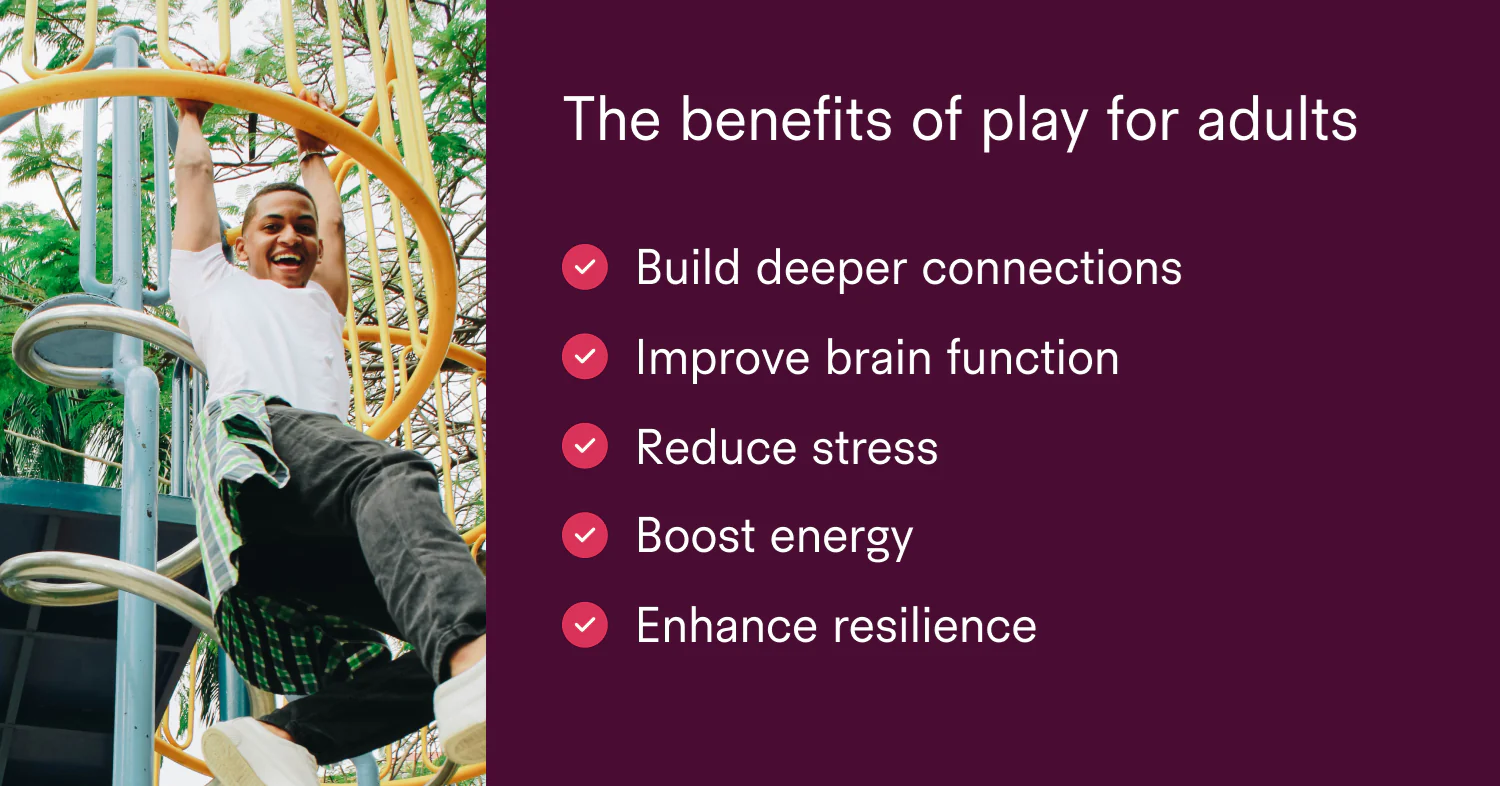
At some point between childhood and professional life, most people stop playing. Not in the metaphorical sense — not as a description of losing some general lightness of spirit — but in the concrete neurological sense: they stop engaging in activities characterised by intrinsic motivation, voluntary participation, and the absorption of attention without instrumental goal-orientation. The activities that replace play in adult life are either productive (work, exercise with performance targets, structured learning) or passive (television, social media scrolling, background music). The specific quality of play — engaged, spontaneous, rule-governed in ways chosen by the participants rather than imposed by external necessity — disappears from most adult lives before forty, and the evidence suggests this disappearance has measurable consequences for cognitive flexibility, creative problem-solving, and the quality of professional performance.
What Play Actually Is and What Its Absence Costs
The Neuroscience of Play in Adult Cognitive Function
The neuroscientific study of play has been conducted primarily in children and non-human animals, where play behaviour is both easier to observe and more universally present. The findings from this research, however, have direct implications for adult cognitive function that researchers have increasingly been applying to professional performance contexts. Play, at the neurological level, activates a distinct mode of brain engagement characterised by simultaneous high arousal and low threat perception — a combination that produces the conditions for novel neural connection formation that underlies creativity, learning, and the cognitive flexibility that complex professional environments require.
The prefrontal cortex, which governs executive function, self-monitoring, and goal-directed behaviour, operates in a partially inhibited state during genuine play — a state that neuroscientists sometimes describe as “transient hypofrontality.” This is the same state produced by flow experiences and associated with the creative insight that emerges when deliberate effort is released and associative thinking takes over. The professional value of this state is well-established in creativity research: the solutions to complex problems that resist direct analytical attack most frequently arrive during states of relaxed, non-goal-directed mental activity rather than during concentrated effort. Play is one of the most reliable methods for producing this state deliberately.
The adult professional who has eliminated play from their life has not simply lost a leisure option — they have eliminated one of the primary mechanisms through which the brain refreshes the cognitive resources that sustained analytical work depletes. The consequences appear in the specific quality of cognitive depletion that characterises professional burnout: not simple tiredness, which sleep resolves, but a loss of creative responsiveness, reduced tolerance for ambiguity, and the narrowing of problem-solving approaches toward familiar patterns that represents a cognitive system operating without sufficient regeneration.
The structure of how the adult entertainment and digital leisure industry has evolved reflects an implicit understanding of this cognitive need even when it does not frame it in neuroscientific terms. Platforms that consolidate multiple forms of interactive leisure — sports engagement, game mechanics, live interactive content — under a single interface are implicitly serving the adult need for play-like engagement rather than purely passive entertainment. A desiplay games betting platform organises its lobby around exactly this multi-format interactive engagement model: sports betting markets that require analytical decision-making, live casino products that involve social interaction with dealers in real time, and instant game formats that provide the rapid reward cycles of structured play without the extended time commitment that traditional games require. The product architecture serves users whose need is not for passive content consumption but for the specific combination of mild challenge, voluntary engagement, and outcome uncertainty that characterises play — and whose professional lives have eliminated most other accessible sources of that combination.
Why Professional Culture Systematically Eliminates Play
The progressive elimination of play from adult professional life is not accidental. It is the predictable consequence of a set of cultural values that professional environments reinforce systematically and that are in direct tension with the psychological conditions play requires.
Play requires voluntary participation — the activity must be chosen rather than obligated. Professional culture progressively fills available time with obligated activities, leaving insufficient unstructured time for play to emerge. A professional whose day is completely scheduled — including their evenings, which contain commitments to family, household management, fitness targets, and professional development — has no temporal space for the spontaneous, self-directed engagement that play requires.
Play requires the absence of instrumental goal-orientation — the activity must be valuable in itself rather than as a means to another end. Professional culture, particularly the productivity culture that has intensified in knowledge work environments over the past two decades, evaluates activities by their contribution to defined goals. A professional who has internalised this evaluative framework finds it difficult to engage with any activity without monitoring whether it is “worth the time” — a monitoring process that is incompatible with the absorbed, self-directed quality of genuine play.
Play tolerates and even requires uncertain outcomes — the point of play is partly the unpredictability of what will happen. Professional culture emphasises risk management, outcome predictability, and the elimination of uncertainty wherever possible. The adult professional who has been trained to avoid uncertainty at work finds the deliberate engagement with uncertain outcomes that characterises play — games, sports, creative exploration without a defined endpoint — psychologically uncomfortable rather than enjoyable.
Recovering Play Capacity as a Deliberate Professional Practice
The Practical Path Back to Genuine Play
The recovery of play capacity in adult professional life requires addressing the three conditions that professional culture has eliminated: temporal space, permission to engage without instrumental justification, and tolerance for uncertain outcomes. Each of these conditions can be deliberately reconstructed, but each requires a specific type of intervention rather than a general intention to “play more.”
Temporal space for play is created by protecting a defined period in the weekly schedule from both professional obligations and productivity-oriented activities — a period that is genuinely unstructured, in which the default is not a scheduled activity but the opportunity for spontaneous engagement with whatever is interesting in the moment. The resistance that most professionals feel toward this suggestion is itself evidence of how thoroughly the obligation-filling impulse has colonised available time. A protected unstructured period feels uncomfortable initially because it is experientially unfamiliar — the cognitive system that has been trained to fill available time with productive activities does not know how to be unproductive, and the discomfort is the experience of that system encountering a situation it has not been trained to navigate.
Permission to engage without instrumental justification is the psychological condition most professionals must explicitly reconstruct, because the productivity culture that eliminates play has also eliminated the legitimacy of activities whose value is intrinsic rather than instrumental. The reframe required is not “this play activity will make me more productive” — which is true but perpetuates the instrumental evaluation framework that is part of the problem — but “intrinsic value is a legitimate reason to do something, independent of any instrumental justification.” This is a cultural value that professional environments actively work against and that must be consciously reclaimed.
The characteristics of activities that most effectively restore play capacity for professional adults are:
- Mild rule structure that is chosen rather than imposed — games, sports, and creative activities with rules that the participant accepts voluntarily, which provides the structured freedom that distinguishes play from either pure chaos or pure obligation
- Social engagement that is non-hierarchical — play activities in which professional status is irrelevant and the social dynamic is determined by the activity itself rather than by professional relationships, which removes the status-monitoring that prevents genuine absorption
- Physical or sensory engagement — activities that involve the body or the senses as primary rather than secondary, which activates embodied attention modes that are less susceptible to the self-monitoring that inhibits adult play
The numbered steps for rebuilding genuine play capacity in a professional life from which it has been progressively eliminated are as follows:
- Identify the activities that produced genuine absorption in childhood or early adulthood, before professional culture had fully displaced them — these activities provide the most reliable starting point for adult play recovery because they engage the specific interests and cognitive styles that characterise the individual’s play profile
- Schedule unstructured time explicitly rather than planning to use “leftover” time for play, because leftover time reliably fills with obligations that feel more urgent than play and that professional culture has trained the person to prioritise
- Engage with activities that have genuine uncertain outcomes rather than choosing activities whose outcomes are controllable and predictable — the tolerance for uncertainty that play requires must be rebuilt through repeated exposure to enjoyable uncertain outcomes, which gradually recalibrates the risk-aversion that professional culture has developed
- Resist the evaluation of play activities by their productive contribution — the impulse to justify play by its productivity benefits is understandable and partly true, but it perpetuates the instrumental orientation that prevents play from delivering its full cognitive benefit, which requires engagement without self-monitoring rather than engagement with a new set of instrumental goals
Conclusion: Play Is Professional Infrastructure
The professional who is too busy to play is in the same position as the athlete who is too focused on competition to train recovery — managing a short-term performance at the expense of long-term capacity. Play is not the opposite of professional seriousness. It is one of the mechanisms through which professional seriousness is made sustainable and through which the creative responsiveness that serious professional work requires is maintained over time. Recovering it is not a lifestyle indulgence for professionals who have earned the right to relax — it is a strategic investment in the cognitive resources that professional performance depends on and that sustained instrumental effort, without sufficient genuine play, will predictably deplete.
